How to Tell Real Leather from Fake: Easy Tips & Tricks
You can tell real leather from fake by checking the label for clear material info and certifications showing genuine sourcing. Feel its texture—it should be soft, flexible, and warm, with natural grain and rough edges.
Smell for a rich, earthy scent, not plastic. Real leather absorbs water and chars rather than melts when exposed to flame.
Watch for uniform grain and smooth edges, which signal fake leather. Keep exploring to uncover more sure-fire ways to spot authenticity.
Read the Label Carefully

When you examine a leather product, always read the label carefully to spot clear wording like “genuine leather” or certifications such as Pelle Conciata al Vegetale. These indicators confirm the authenticity of the leather.
If the label mentions synthetic terms like “PU,” “PVC,” or “vegan leather,” you’re dealing with faux leather, not the real thing. Be cautious if the label is vague or missing. Authentic leather products usually provide detailed material information.
Check for the country of origin and leather sourcing details; reputable brands include these to ensure transparency. Also, look out for certifications from organizations like the Leather Working Group (LWG), which highlight responsible leather production.
Feel the Texture and Flexibility

When you touch real leather, you’ll notice its soft, grainy texture and natural irregularities. It feels warm and flexible, bending easily without stiffness.
In contrast, fake leather often feels cold, smooth, and rigid, lacking that natural stretch and softness.
Texture Characteristics
How does leather feel when you touch it? Genuine leather comes with a soft, supple texture that instantly feels warm and inviting. When you run your fingers over it, you’ll notice a natural grainy surface that varies subtly, unlike the uniform smoothness of fake leather.
Real leather’s texture is slightly stretchy and pliable, conforming comfortably to your touch. In contrast, fake leather often feels cold and stiff, with a plastic-like finish that lacks flexibility.
When you bend authentic leather, it reveals resilience without cracking or peeling, showing its durability. This natural texture characteristic helps you distinguish real leather easily. Trust your sense of touch to recognize the warmth, grain, and softness that genuine leather comes with, setting it apart from synthetic alternatives.
Flexibility and Stretch
Although it might not be immediately obvious, genuine leather’s flexibility and stretch set it apart from fake alternatives. When you handle real leather, you’ll notice it’s soft, pliable, and slightly stretchy, adapting comfortably to your hand or body shape.
Unlike faux leather, which often feels stiff or rigid, real leather bends and folds without cracking or losing its shape. You can test this by gently bending a leather piece; real leather maintains its integrity and springiness.
Its grainy surface allows for natural stretch and movement, making it more durable over time. This flexibility ensures real leather remains comfortable and resilient, proving its authenticity every time you touch or flex it.
Temperature and Softness
The way leather feels against your skin offers clear clues about its authenticity. Genuine leather goods feel warm and soften as you hold them, while fake leather stays cold and plasticky.
Real leather is soft, supple, and slightly stretchy, adapting comfortably to your touch. It compresses when pressed and quickly bounces back, showing flexibility fake leather lacks.
| Feature | Real Leather | Fake Leather |
|---|---|---|
| Temperature | Warm, warms up with touch | Cold, plastic-like |
| Softness | Soft, supple, slightly stretchy | Rigid, stiff, uniform |
| Texture | Natural grain, uneven | Smooth, uniform |
Feel the texture and flexibility to judge your leather goods’ authenticity confidently.
Perform a Smell Test

Why trust your nose when trying to spot real leather? Because genuine leather has a distinctive earthy, woodsy, or oaky smell that’s tough to fake. When you perform a smell test, take a moment to sniff the material in a well-ventilated area, so subtle scents come through clearly.
If you catch a plastic or chemical odor, it’s likely faux leather, especially in cheaper items. Keep in mind, some high-quality vegan leathers may have little to no smell at all, making scent less reliable on its own.
Examine the Grain and Edges
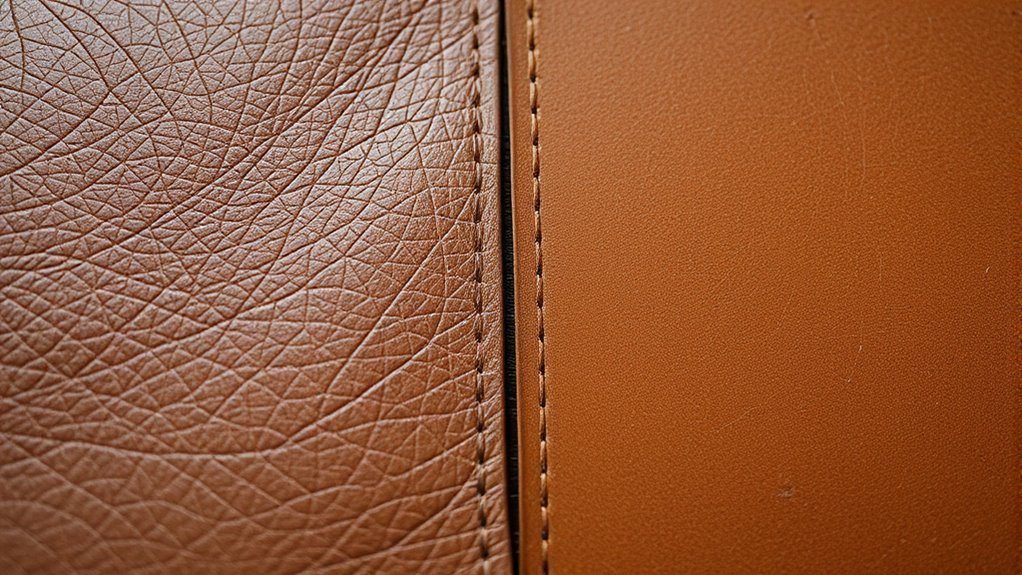
Take a close look at the surface grain patterns. Real leather has irregular, natural-looking pores, while fake leather appears too uniform.
Check the edges too; genuine leather’s edges are rough and fibrous, unlike the smooth, machine-cut edges of synthetic material. Noticing these differences helps you spot authentic leather quickly.
Surface Grain Patterns
How can you tell if leather is real just by looking at its surface? When getting real leather, you need to know how leather looks compared to vegan leather. The surface grain patterns reveal a lot and help explain the differences between the real thing and synthetic types.
Real leather shows irregular, natural grain and pores, making it a popular type of leather for authenticity seekers. In contrast, vegan leather usually has a uniform, printed pattern.
Look for these signs:
- Inconsistent, natural grain and minor imperfections
- Rough, uneven edges showing natural fibers
- Fibrous, layered structure when cut
Understanding these details helps you spot genuine leather and avoid fake alternatives.
Edge Texture Differences
Although surface grain patterns give you clues about leather authenticity, examining the edges reveals even more. When you look closely, genuine leather edges appear rough and uneven, showing natural fibers and a layered structure.
In contrast, fake leather edges are smooth, clean-cut, and uniform, often with a flat, plastic-like backing. Real leather’s grain is inconsistent, featuring natural pores and imperfections, while synthetic leather’s grain is perfectly uniform or printed.
You’ll notice authentic leather edges may have a raw, unfinished look or a slightly polished finish, unlike the sharp, machine-cut finish on fake leather. By focusing on these edge texture differences, you can confidently distinguish real leather from fake, spotting the unique surface irregularities that synthetic materials lack.
Conduct a Flame Test Safely
When you hold a small flame close to the leather for a few seconds, you’ll notice distinct reactions that help you identify its authenticity. To conduct the flame test safely, follow these steps:
Hold a lighter’s flame near a small, hidden area of the leather for 5-10 seconds, avoiding large sections. Place the leather on a metal or non-flammable surface to prevent accidental fires or damage.
Observe the smell and reaction: genuine leather chars and smells like burnt hair, while fake leather melts or emits a chemical odor.
Always extinguish the flame immediately after testing and guarantee you’re in a well-ventilated area to avoid inhaling fumes. This careful approach lets you test leather without causing unnecessary damage or risk.
Test Water Absorption
After safely conducting the flame test, you can move on to another straightforward method: testing water absorption. Drop a few small droplets onto the leather surface and watch closely.
Genuine leather absorbs water quickly, leaving a damp spot due to its porous nature. In contrast, fake leather repels water, causing it to bead up and sit on the surface.
This test is quick, non-destructive, and effective when combined with other checks.
| Material Type | Water Behavior | Surface Characteristic |
|---|---|---|
| Genuine Leather | Absorbs quickly | Porous, natural fibers |
| Synthetic Leather | Water beads up | Non-porous, smooth |
| Genuine Leather | Damp spot visible | Hide structure evident |
| Synthetic Leather | Water pools | Plastic-like texture |
| All Tests Used | Confirm authenticity | Combine for best result |
Understand Labeling and Certification Standards
Since genuine leather products come with specific labels, you should always check for terms like “full-grain,” “top-grain,” or “vegetable-tanned,” which indicate quality and authenticity. These labels often include details about the leather’s origin, helping you trace its source.
Look for labels like full-grain, top-grain, or vegetable-tanned to ensure genuine leather quality and trace its origin.
Certifications also play a key role in verifying real leather. When shopping, look for:
- Leather Working Group (LWG) badges for eco-friendly and responsibly sourced leather.
- Clear labeling of material type, specifying leather, synthetic, or vegan, often with percentage composition.
- Official certification marks that confirm authenticity and manufacturing standards.
If labels are missing or vague, it’s a warning sign the product might be fake or synthetic. Trust reputable brands that provide transparent information about their leather’s sourcing and certification.
Frequently Asked Questions
How Can You Tell if Leather Is Real?
You can tell if leather is real by feeling its softness and warmth, smelling its natural earthy scent, checking for irregular grain patterns, and seeing if it absorbs water instead of repelling it like fake leather does.
What Does Fake Leather Look Like?
Fake leather looks shiny and uniform, often with a plastic-like surface. You’ll notice smooth edges and repetitive grain patterns.
It feels cold and stiff, and when cut, you might see a fabric backing beneath the surface.
What Is the Symbol for Real Leather?
The symbol for real leather usually looks like a stylized animal hide or leather icon on labels. You’ll often see text like “Genuine Leather” alongside it, confirming the product’s authenticity and helping you avoid fakes.
How to Differentiate Between Leather and Synthetic Leather?
Think of leather like a fingerprint; no two pieces are alike. You’ll spot real leather by its uneven grain, warm touch, and water absorption.
Synthetic leather feels cold, uniform, and repels water, like plastic hiding its true self.
Conclusion
Now that you know how to tell real leather from fake, trust your touch, trust your nose, and trust your eyes. Read the label carefully, feel the texture and flexibility, and perform a smell test.
Examine the grain and edges, conduct a flame test safely, and test water absorption. By understanding these steps and recognizing certification standards, you’ll confidently choose genuine leather every time.
This ensures quality, durability, and authenticity in your purchase, helping you distinguish real leather from fake with ease and confidence.